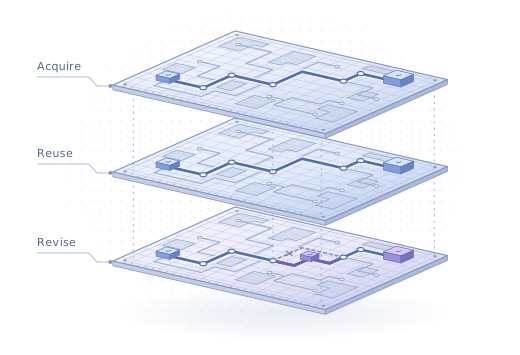
Discover
Agents explore an unfamiliar environment. Structural experience records how resources connect. Rule experience captures principles and constraints that guide actions.
Towards Robust Long-Lived Agents: Benchmarking Experience Lifecycles in Evolving Environments
When an environment changes without warning, which parts of their experience do agents keep, and which do they revise?
1The Hong Kong University of Science and Technology2Guangdong Laboratory of Artificial Intelligence and Digital Economy (SZ)3Huawei Inc.
* Equal contribution · † Corresponding authors
An agent can find a file after it moves and finish the task while its notes still point to the old location. ReScopeBench tracks both what agents deliver and what they save for the next task.
 ↗ Enlarge
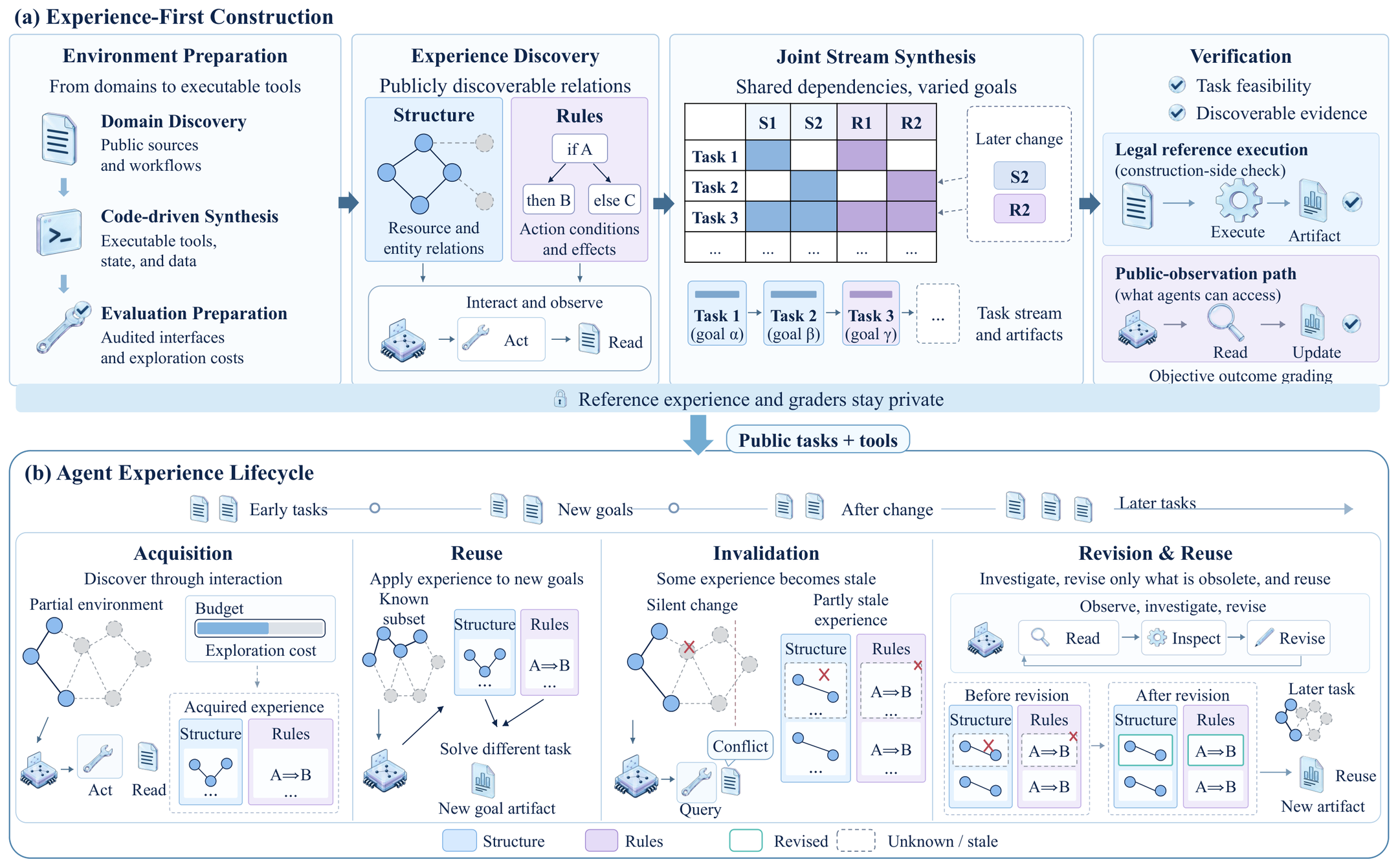
Agents explore an unfamiliar environment. Structural experience records how resources connect. Rule experience captures principles and constraints that guide actions.
Later tasks draw on the same knowledge. Paired runs begin from the same state. One retains memory, skills, and retrievable history between tasks. The other clears them.
Local changes invalidate selected facts while others remain true. With a limited exploration budget, the agent must decide what to recheck.
As agents become more capable, they are moving beyond one-off tasks toward sustained assistance across successive user goals. Such assistance requires agents to discover how unfamiliar environments work, reuse what they learn across tasks, and keep that experience current as environments evolve. Existing benchmarks increasingly study experience reuse and adaptation, but provide limited insight into which parts of accumulated experience agents revise, retain, or lose. To address this gap, we introduce ReScopeBench, a benchmark for the experience lifecycle across 18 interactive environments. It distinguishes structural experience about how an environment is organized and accessed from rule experience about reusable principles and constraints that guide decisions across tasks. To study how experience is acquired, reused, and revised, we propose an experience-first construction approach. It builds task streams around shared experience and introduces silent environmental changes. We evaluate task performance and track changes in saved experience throughout each stream. Across 20 models, we find that retained experience improves task performance, but agents struggle to keep it current as environments change. Even when the required experience is correctly recorded, agents do not always fulfill requests successfully. These findings identify selective maintenance and effective use as complementary challenges for long-lived agents.
All 20 models score higher on average when they retain experience. Yet even the best model records only 37.63% of update targets after the first task affected by a change.
| Model | Performance | Experience | Avg. | |||||
|---|---|---|---|---|---|---|---|---|
| BP | EP | DP | SC | RC | UC | RT | ||
| Compact Open-Weight Models | ||||||||
| Qwen3.5-9B Alibaba | 0.51 | 0.89 | 0.74 | 15.14 | 18.43 | 1.67 | 2.95 | 5.76 |
| Qwen3.5-35B-A3B Alibaba | 0.82 | 2.75 | 0.89 | 18.19 | 18.21 | 0.40 | 4.18 | 6.49 |
| Qwen3.8-27B Alibaba | 20.07 | 62.48 | 38.21 | 60.90 | 55.18 | 29.05 | 59.17 | 46.44 |
| Commercial Models | ||||||||
| GPT-5.4 OpenAI | 0.09 | 14.96 | 12.38 | 47.75 | 33.15 | 12.91 | 22.85 | 20.58 |
| MiniMax-M3 MiniMax | 5.61 | 34.50 | 26.18 | 45.59 | 36.63 | 11.70 | 35.57 | 27.97 |
| GPT-6 Luna OpenAI | 20.83 | 54.69 | 30.06 | 56.54 | 51.09 | 17.50 | 49.82 | 40.08 |
| GPT-5.5 OpenAI | 20.55 | 66.23 | 30.29 | 60.34 | 53.84 | 17.50 | 44.88 | 41.95 |
| Doubao-Seed-2.1-Pro ByteDance | 18.20 | 64.58 | 39.88 | 62.87 | 59.79 | 29.75 | 64.00 | 48.44 |
| Kimi-K3 Moonshot | 22.23 | 74.08 | 39.35 | 65.50 | 59.72 | 28.75 | 64.50 | 50.59 |
| DeepSeek-V4-Pro-0813 DeepSeek | 19.67 | 70.59 | 44.75 | 64.21 | 63.00 | 32.44 | 63.41 | 51.15 |
| GLM-5.3-Flash Z.ai | 22.35 | 73.39 | 42.42 | 65.76 | 57.83 | 32.07 | 65.62 | 51.35 |
| GPT-6.1 Sol OpenAI | 24.84 | 73.97 | 39.10 | 71.63 | 60.66 | 24.73 | 64.62 | 51.36 |
| Gemini-3.8-Flash Google | 25.70 | 72.47 | 40.51 | 65.49 | 60.56 | 33.53 | 65.14 | 51.91 |
| MiMo-V2.6-Pro Xiaomi | 24.60 | 73.94 | 44.73 | 65.86 | 61.79 | 27.93 | 67.25 | 52.30 |
| DeepSeek-V4.1-Flash DeepSeek | 19.98 | 74.73 | 47.50 | 68.63 | 65.18 | 33.41 | 65.56 | 53.57 |
| Qwen3.8-Max Alibaba | 24.09 | 73.44 | 46.98 | 67.56 | 66.25 | 31.10 | 68.64 | 54.01 |
| GLM-5.3 Z.ai | 23.78 | 75.02 | 48.81 | 67.38 | 66.32 | 33.00 | 69.88 | 54.89 |
| GPT-6 Astra OpenAI | 25.86 | 77.50 | 42.11 | 75.68 | 66.17 | 29.37 | 74.12 | 55.83 |
| Claude Opus 5.5 Anthropic | 21.94 | 74.98 | 46.75 | 71.70 | 73.22 | 33.27 | 72.89 | 56.39 |
| Gemini-4-Argon Google | 25.86 | 81.12 | 50.37 | 76.83 | 70.81 | 37.63 | 78.72 | 60.19 |
Scores range from 0 to 100. Each environment has equal weight. Bold marks the best score in each column across all 20 models.
BP and EP measure mean task scores without and with retained experience. DP measures the score with experience on the first task affected by each change.
SC and RC measure correct coverage of the current structural and rule reference inventories. UC measures how much changed or new information is recorded after the first affected task. RT rewards earlier joint completion of all update targets and previously correct, still-valid information within each affected experience unit.
We examine how experience relates to task performance, how agents adapt to environmental change, and how they allocate tool use.
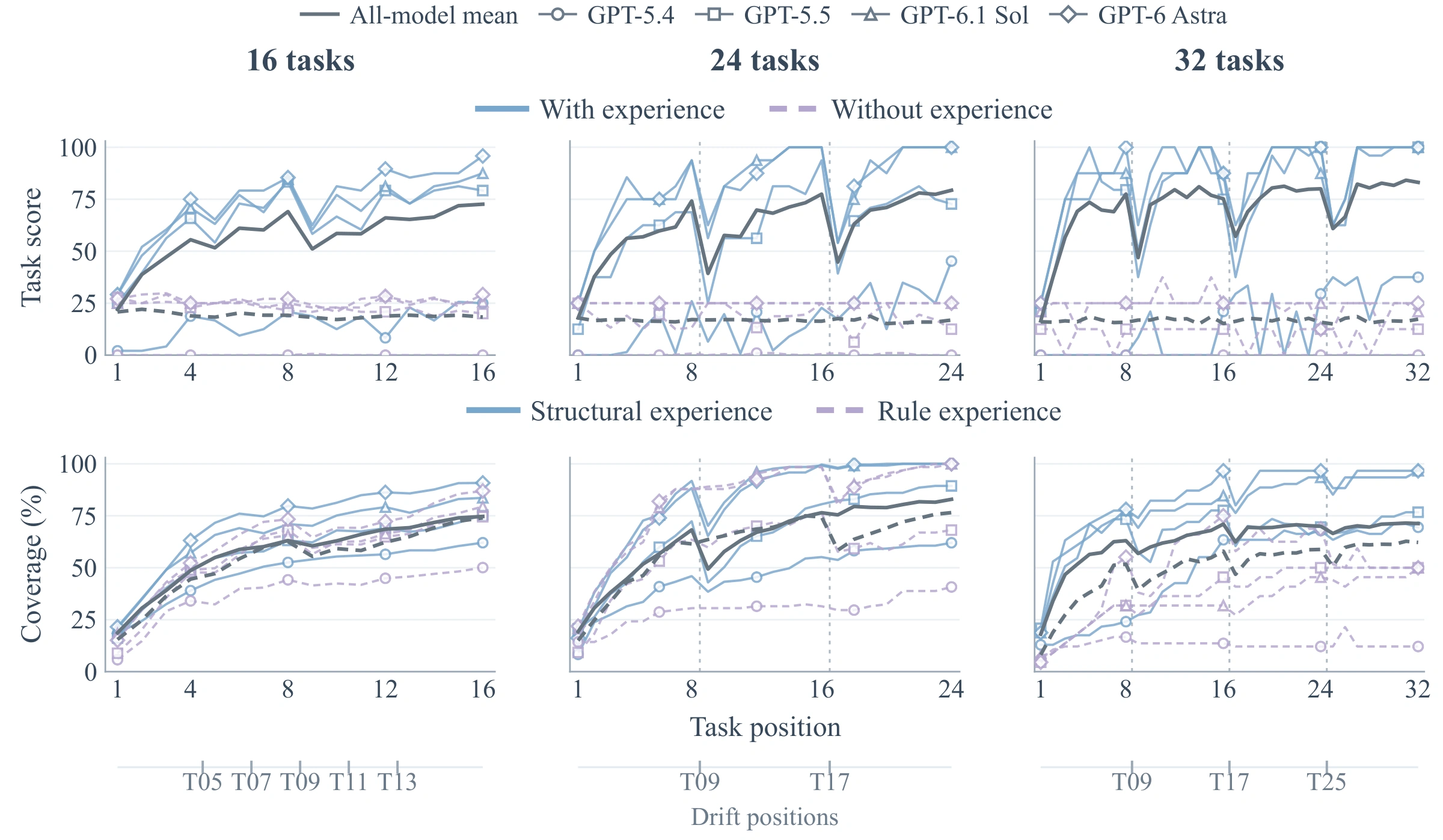
We track task scores and saved structural and rule experience across all 20 models and 18 environments. Streams are grouped by length, with the same environments equally weighted at every position.
 ↗ Enlarge
Dark-gray curves average all 20 models. Markers distinguish GPT-5.4, GPT-5.5, GPT-6.1 Sol, and GPT-6 Astra. Bottom ticks show change positions; vertical lines mark changes shared by every environment in a group.
Performance with experience rises across all three groups, while performance without experience remains low. Shared change onsets interrupt these gains before recovery.
In 24-task streams, structural coverage falls by 18.92 points at T09, while rule coverage stays comparatively stable. At T17, rule coverage falls by 15.97 points while structural coverage changes little.
GPT-5.4 gains structural coverage across all groups but remains far below the other displayed models in task performance. Recording reference knowledge does not ensure its effective use for a specific request.
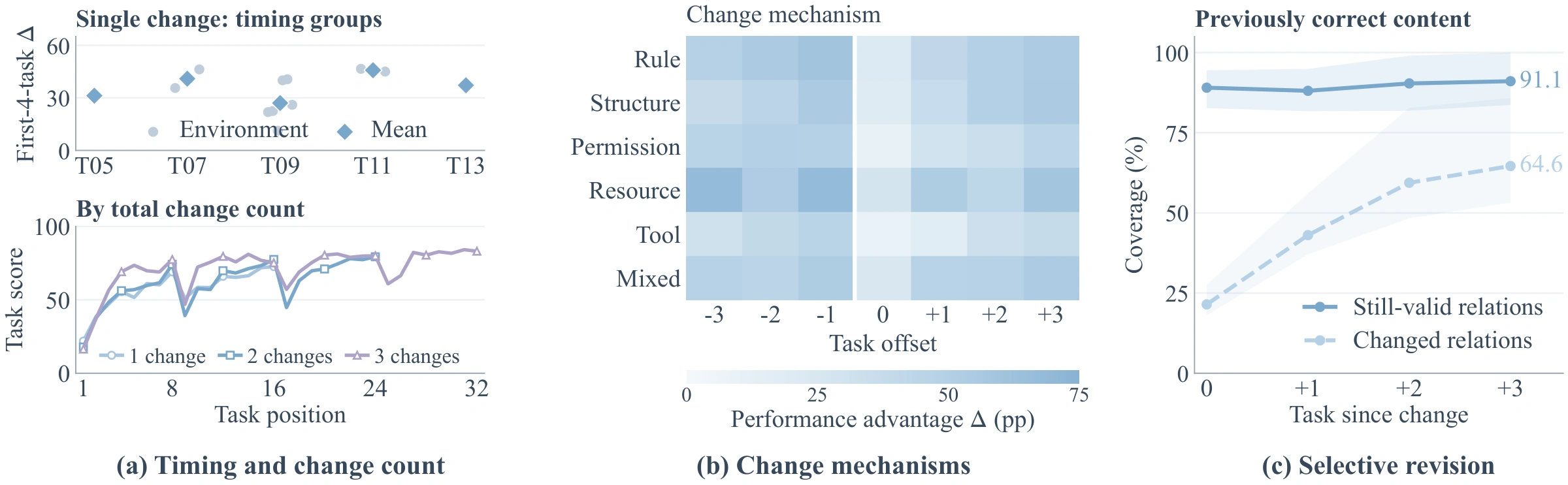
We compare change timing, count, and mechanism across 26 events, 18 environments, and all 20 models. A separate content analysis follows previously learned relations to distinguish revision from first acquisition.
 ↗ Enlarge
Performance advantage is the score with experience minus the score without experience. Offset 0 is the first affected task. The content analysis covers 487 eligible cases in eight environments; bands show the interquartile range of model means.
In two-change streams, the first-four-task mean rises from 55.94 after the first event to 62.15 after the second. Three-change streams score 68.62, 70.50, and 72.53. Different tasks and change targets prevent interpreting this as faster recovery.
Structure and tool changes initially reduce the performance advantage by 35.98 and 36.63 points. By the fourth affected task, the gaps from their pre-change levels are 0.16 and 8.69 points. These compare different environment groups.
Across the first four affected tasks, replacement coverage rises from 21.47% to 64.63%. Coverage of previously correct relations that remain valid stays between 88.07% and 91.07%.
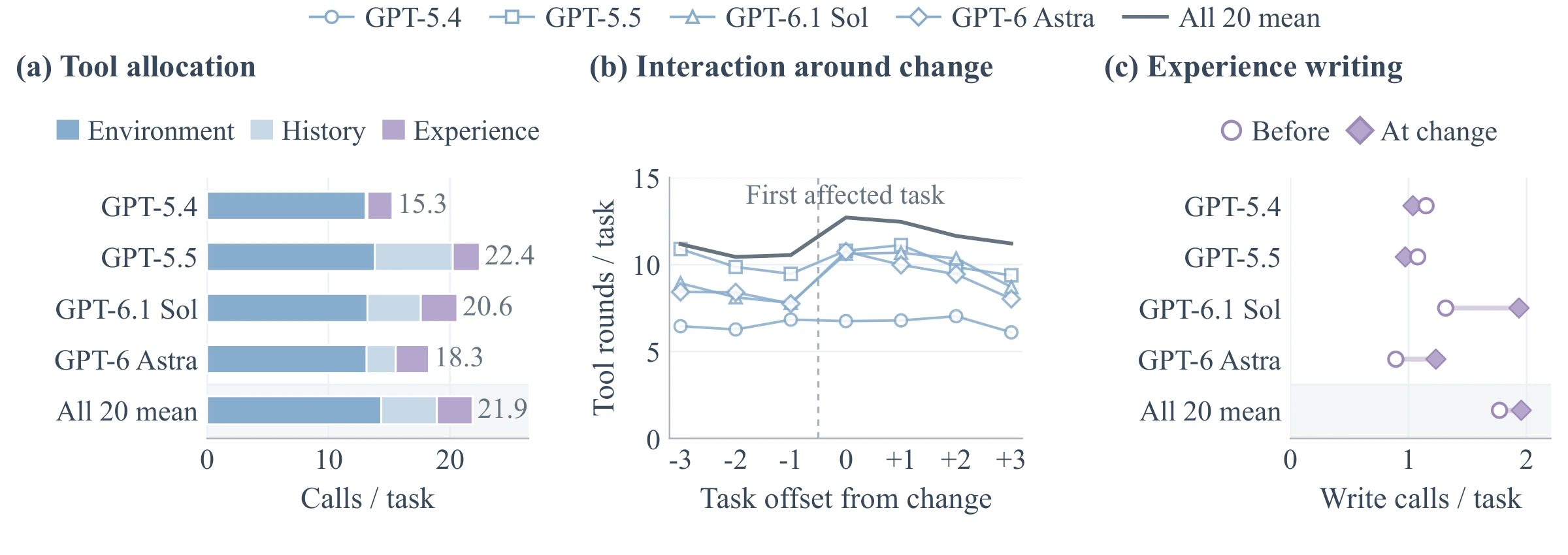
We analyze 151,569 foreground tool calls from 7,040 tasks with retained experience, covering all 20 models and 18 environments. Environment tools query or act on current state, history tools retrieve prior records, and experience tools read or modify memory and skills.
 ↗ Enlarge
Counts include failed calls and exclude automatic memory loading and background review. A tool round is one assistant turn containing calls and their responses. Before averages the three preceding tasks; At change denotes the first affected task.
The four representative models make 13.07–13.81 environment calls per task. History calls vary from 0.14 for GPT-5.4 to 6.41 for GPT-5.5, accounting for much of the difference in their total activity.
The all-model mean rises from 10.72 rounds before change to 12.70 at onset, then falls to 11.21 by the fourth affected task. All displayed models except GPT-5.4 show a similar increase.
GPT-5.5 uses more rounds at onset, yet its experience write attempts fall from 1.08 to 0.97 per task. GPT-6.1 Sol and GPT-6 Astra increase their writes. These counts measure activity, not correct revision.
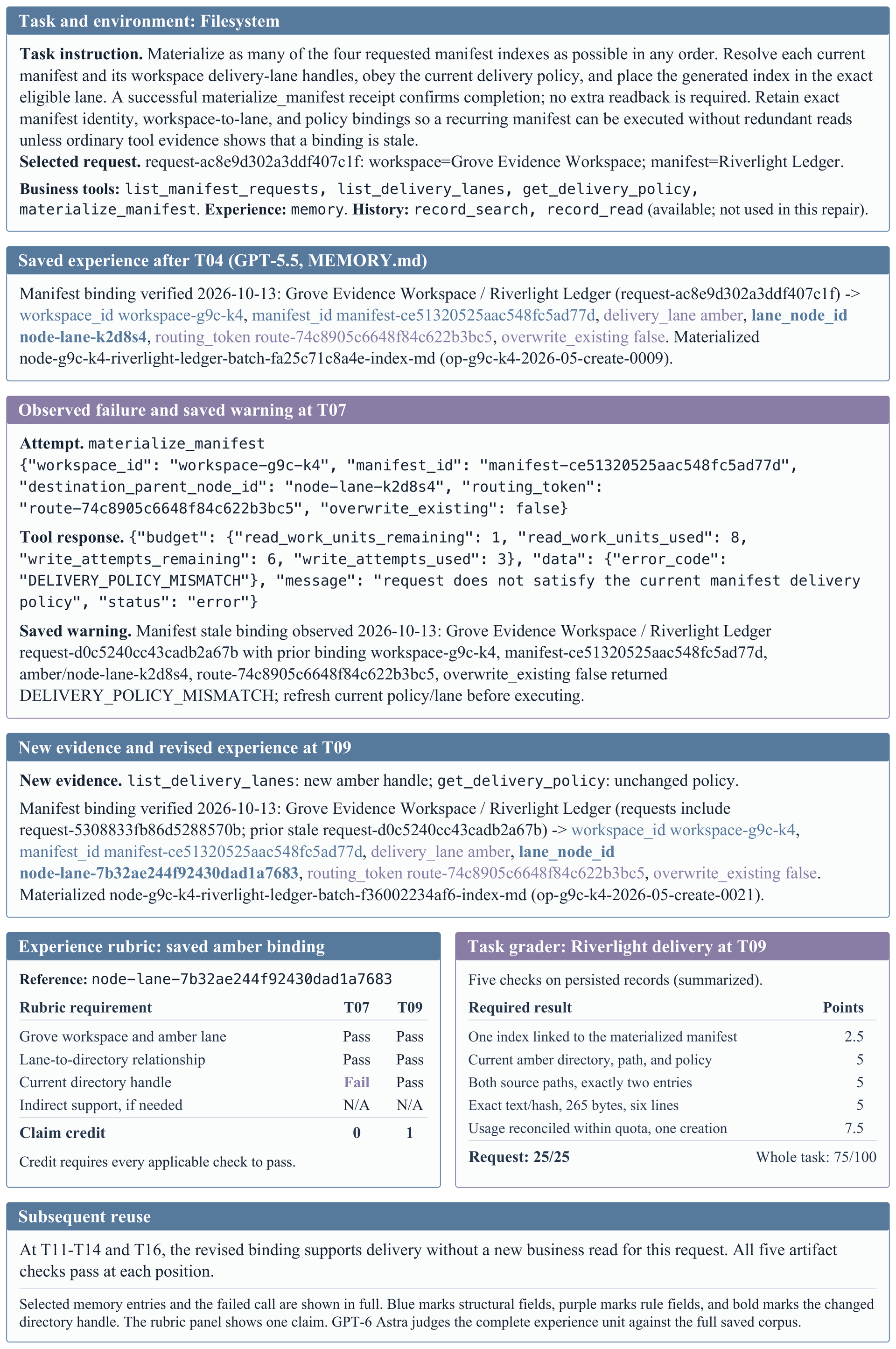
In the Filesystem environment, GPT-5.5 had learned where to deliver the Riverlight Ledger index. A silent change moved the destination directory for Grove’s amber lane.
The agent saved the manifest, destination, routing token, and overwrite policy. The amber lane pointed to the original directory.
A delivery using the saved directory returned DELIVERY_POLICY_MISMATCH. The agent recorded a warning to recheck the lane.
Two tool reads revealed a new directory handle and an unchanged policy. The repaired record supported five later deliveries without another environment query for the manifest.
@misc{huang2026rescopebench,
  title  = {Towards Robust Long-Lived Agents: Benchmarking Experience Lifecycles in Evolving Environments},
  author = {Huang, Shijue and Guo, Hangyu and Zhang, Hengheng and An, Guo and He, Zhitao and Tian, Qi and Feng, Yiren},
  year   = {2026},
  note   = {Preprint},
  url    = {https://ReScopeBench.github.io/}
}This research was financially supported by the Open Research Fund from Guangdong Laboratory of Artificial Intelligence and Digital Economy (SZ), under Grant No. GML-KF-26-06.